Key Takeaways
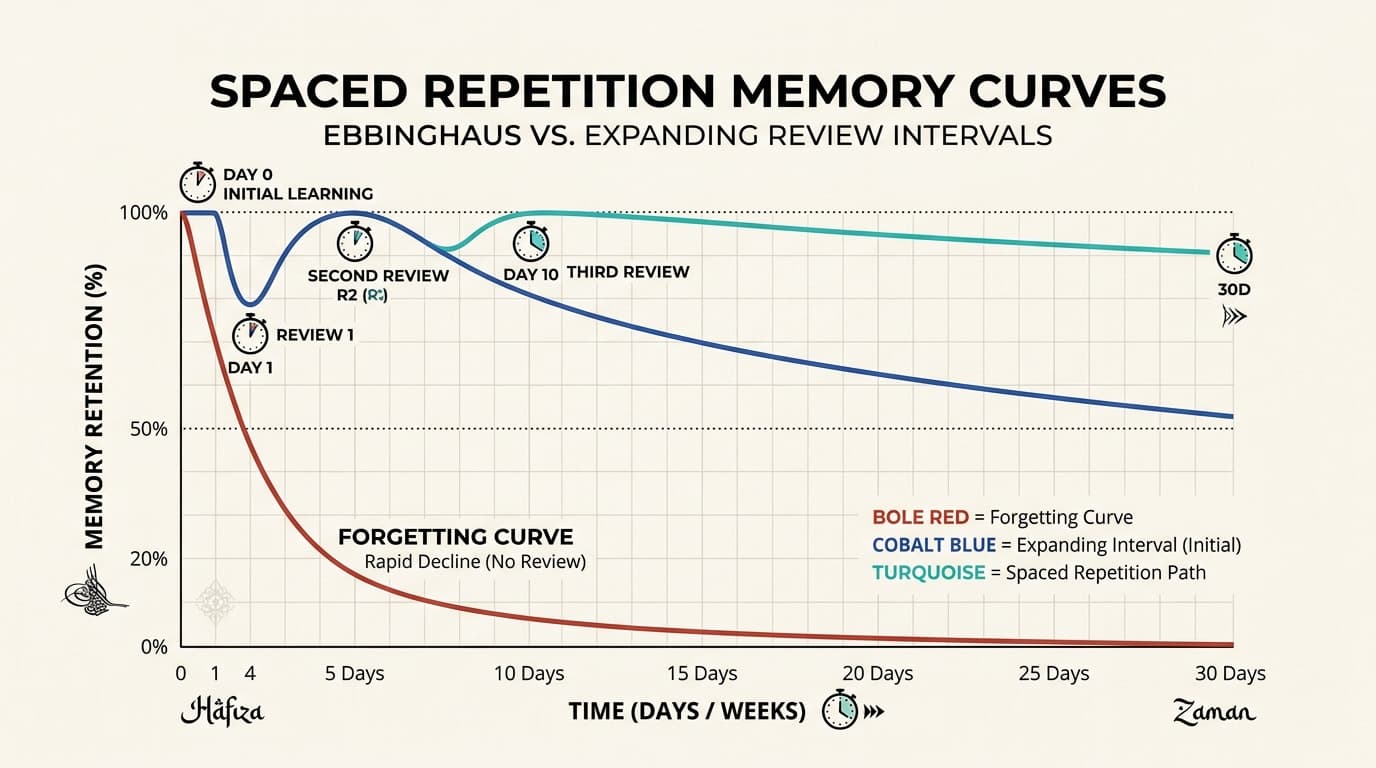
- ✓The forgetting curve shows that without active recall, over 70% of new vocabulary is lost within 48 hours.
- ✓Spaced repetition schedules reviews at expanding intervals right before a memory expires.
- ✓The SM-2 algorithm calculates individual ease factors for each word based on four rating grades.
- ✓Agglutinative words benefit doubly from SM-2 because roots and suffixes reinforce each other across reviews.
The Challenge of Vocabulary Amnesia
Every language learner knows the frustrating experience: you study twenty new Turkish words on Monday, feel confident on Tuesday, and by Friday only remember three.
This is not a personal failure; it is the natural consequence of human memory biology. In 1885, psychologist Hermann Ebbinghaus mapped the exponential rate at which new memories decay when not retrieved.
How Spaced Repetition Flattens the Forgetting Curve
Every time you retrieve a memory from your brain through active recall: struggling slightly to produce the answer before seeing it: the neural pathway strengthens and the decay rate slows.
Spaced Repetition Systems (SRS) calculate the optimal moment for your next review: not when the memory is fresh (which wastes study time) and not after it has vanished (which forces relearning), but precisely when it is on the verge of fading.
The Active Recall Difference
Passive re-reading creates an illusion of competence. Active recall: prompting yourself with the Turkish audio or Arabic/English prompt before flipping: builds durable memory traces.
Inside the SM-2 Algorithm
Dilsever uses the SuperMemo SM-2 algorithm, one of the most rigorously tested cognitive models in existence. Each review card tracks three dynamic variables:
1. Repetition Count (n): Number of consecutive successful recalls.
2. Ease Factor (EF): A dynamic difficulty score starting at 2.5 and adjusting based on your performance.
3. Interval (I): The number of days until the next scheduled review.
When you grade a card as "Easy", the interval multiplies faster. When you rate "Again", the card drops back into the learning queue without breaking your overall study statistics.
Why SM-2 Is Uniquely Effective for Turkish
Because Turkish words share common root morphemes and harmonic suffix patterns, spaced reviews create compound memory effects. Reviewing the verb "yazmak" (to write) reinforces your recall of "yazar" (author), "yazı" (writing), and "yazışmak" (to correspond).
With Dilsever’s daily study log and targeted review queue, you spend just 10 to 15 focused minutes a day while maintaining over 90% long-term retention.
Practice What You Just Learned
Test your Turkish morphology intuition and verb conjugations with instant feedback in Dilsever’s dedicated labs.