Key Takeaways
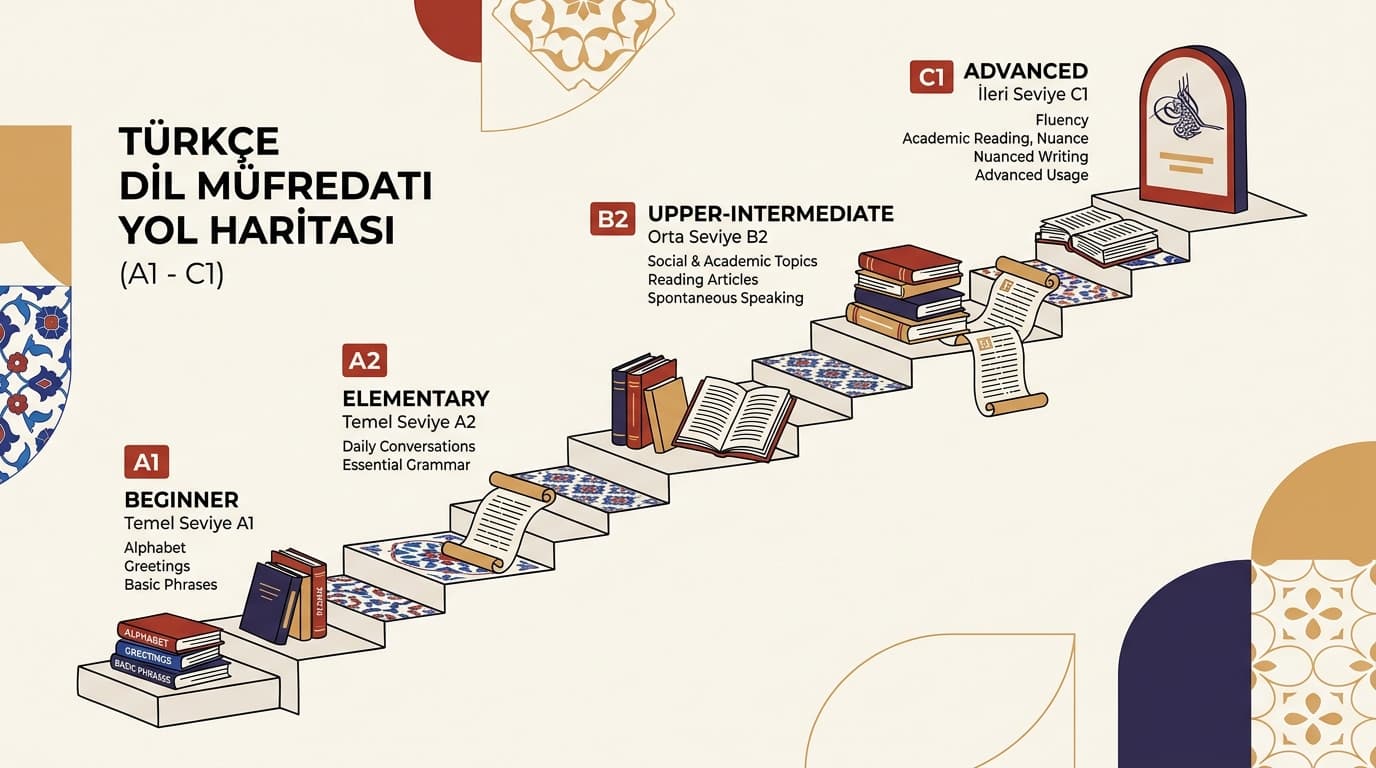
- ✓The CEFR framework is the international benchmark for structured Turkish language learning.
- ✓A1 establishes the sound system, present continuous (-iyor), case endings, and essential daily interactions.
- ✓A2 introduces past tense (-di), future tense (-ecek), comparisons, and directional storytelling.
- ✓B1 and B2 transition learners into complex subordination, reported speech (-miş), and relative clauses.
- ✓Dilsever maps directly to CEFR standards for systematic, verifiable progression.
Why the CEFR Framework Is the Global Benchmark
Whether you are learning Turkish for residency, university admission, business, or cultural enrichment, following the Common European Framework of Reference for Languages (CEFR) provides a clear, measurable roadmap.
Unlike unstructured phrasebook courses, the CEFR standard scaffolds grammatical complexity so that every new suffix builds logically on previously mastered foundations.
Level A1: The Building Blocks (Core Foundation)
A1 focuses on high-frequency survival language and the foundational mechanics of Turkish:
Module 1: Alphabet, vowel harmony basics, formal greetings, and numbers 0 to 100.
Module 2: Classroom objects, demonstratives (bu, şu, o), and plural suffixes (-lar/-ler).
Module 3: Daily routines, question particle (mı/mi), and the Present Continuous tense (-iyor).
Module 4: Family relations, possessive suffixes, and genitive constructions (Ali’nin evi).
Module 5: City navigation, dative/locative/ablative case endings, and asking directions.
Module 6: Free time, abilities with modal verbs, and basic compound nouns.
A1 Vocabulary Target
Expect to master approximately 800 core words and 32 foundational grammar patterns in A1.
Level A2: Conversational Confidence (Elementary)
A2 bridges the gap between basic questions and full narrative ability:
Module 1: The Definite Past Tense (-di/-dı), narrating weekend stories and past events.
Module 2: Future Tense (-ecek/-acak), making plans, reservations, and appointments.
Module 3: Food culture, recipes, imperative forms, and expressing necessity (-meli/-malı).
Module 4: Travel experiences, weather descriptions, and comparative/superlative markers (daha, en).
Module 5: Health, illnesses, doctor visits, and expressing desires with the optative mood (-elim/-elim).
Module 6: Technology, media, expressing frequency (bazen, sık sık), and compound verb structures.
Levels B1, B2 and Beyond: Nuance and Subordination
Intermediate Turkish shifts from simple sentence combinations to rich subordinate clauses:
Reported / Evidential Past (-miş): Distinguishing firsthand knowledge from hearsay or surprise realizations.
Relative Clauses (-en, -dik, -ecek): Creating sophisticated descriptive phrases like "the book I read yesterday" (dün okuduğum kitap).
Converbs (-erek, -ince, -dikçe): Connecting actions with temporal and manner precision.
How Dilsever Accelerates Your Progression
Standard study materials provide grammar tables, but they rarely provide the spaced repetition drills required to lock vocabulary into permanent memory.
Dilsever aligns its Instant Decks, Suffix Lab drills, and conjugation exercises to the exact CEFR modules, turning study into long-term mastery.
Practice What You Just Learned
Test your Turkish morphology intuition and verb conjugations with instant feedback in Dilsever’s dedicated labs.