Key Takeaways
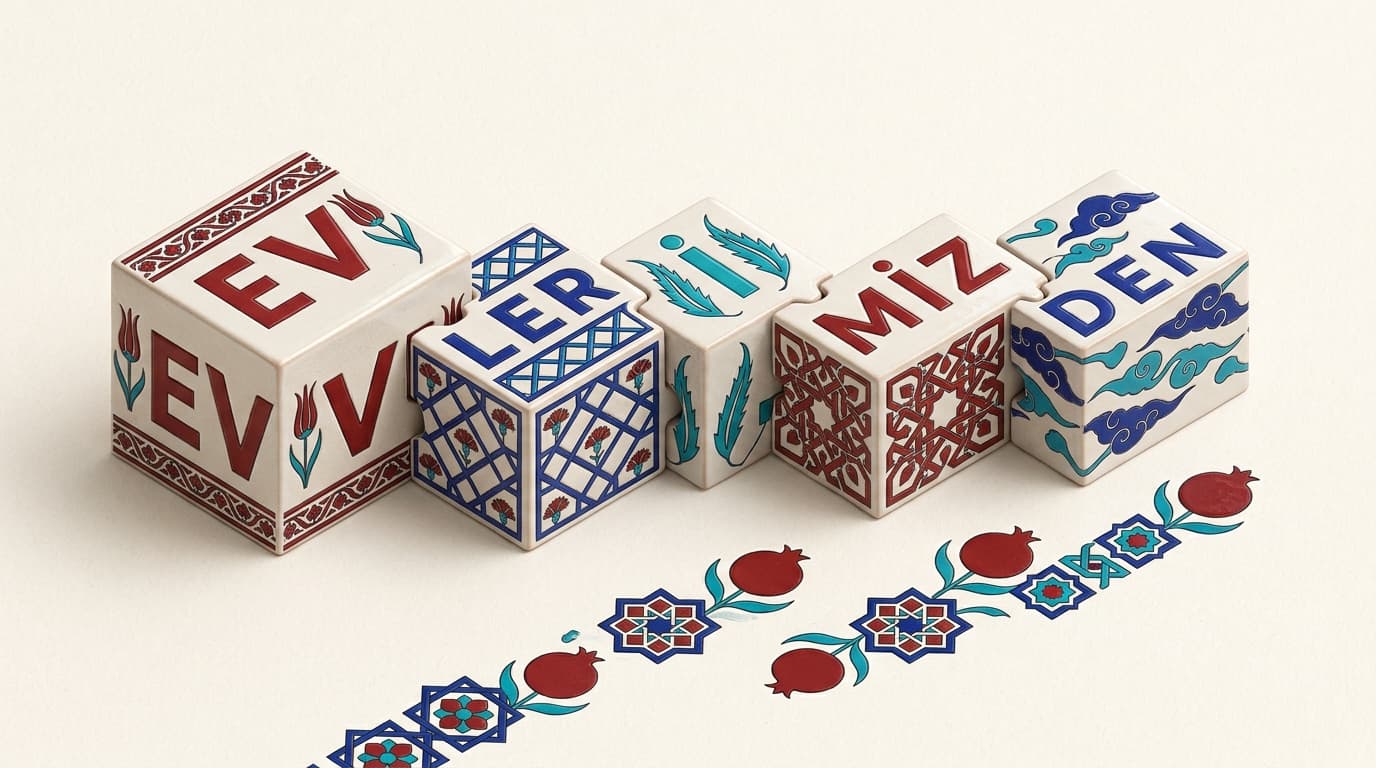
- ✓Turkish is an agglutinative language: words are formed by chaining suffixes to an unchanging root.
- ✓Vowel harmony dictates the vowel of each suffix: 2-way (A-type) and 4-way (I-type).
- ✓Suffix order is strictly rule-based: plural + possessive + case ending.
- ✓Understanding the joins prevents rote memorization of thousands of inflected forms.
What Does Agglutination Actually Mean?
In many Western languages, prepositions and helper words float separately around nouns and verbs: "in my houses", "from their schools", "are you coming?". In Turkish, all of these relationships attach directly to the end of the root word like train cars connected to an engine.
The root word remains stable and recognizable at the front. The suffixes follow a predictable sequence, each carrying one unambiguous packet of grammatical information.
The Engine of Turkish: Two Types of Vowel Harmony
How does a suffix know which vowel to use? Turkish vowels are split into two phonetic dimensions: front vs back, and unrounded vs rounded.
Two-way harmony (A-type) choices are simple: if the preceding vowel is back (a, ı, o, u), use "a". If it is front (e, i, ö, ü), use "e". This governs plurals (-lar/-ler) and basic locative endings.
Four-way harmony (I-type) is even more refined: vowels pair into ı, i, u, or ü depending on both backness and lip rounding. This shapes possessives (-ım/-im/-um/-üm) and past tense markers.
The Golden Rule of Harmony
The last vowel of the preceding syllable always dictates the vowel of the incoming suffix. Harmony never skips syllables.
The Fixed Order of Suffixes on Nouns
Turkish noun suffixation follows a strict, non-negotiable sequence that makes sentence parsing crystal clear:
1. Base Noun Root (e.g. göz: eye)
2. Plural Marker (-ler / -lar)
3. Possessive Marker (-im, -in, -i, -imiz, -iniz, -leri)
4. Case Ending (Accusative -i, Dative -e, Locative -de, Ablative -den, Genitive -in)
Turning Knowledge Into Fluent Intuition
When you stop memorizing inflected forms as isolated vocabulary items and start seeing the joins, Turkish transforms from an intimidating wall of letters into a logical, rhythmic construction set.
Dilsever’s Suffix Lab was designed specifically to train this visual and auditory intuition through tactile tile drills and instant feedback.
Practice What You Just Learned
Test your Turkish morphology intuition and verb conjugations with instant feedback in Dilsever’s dedicated labs.