Key Takeaways
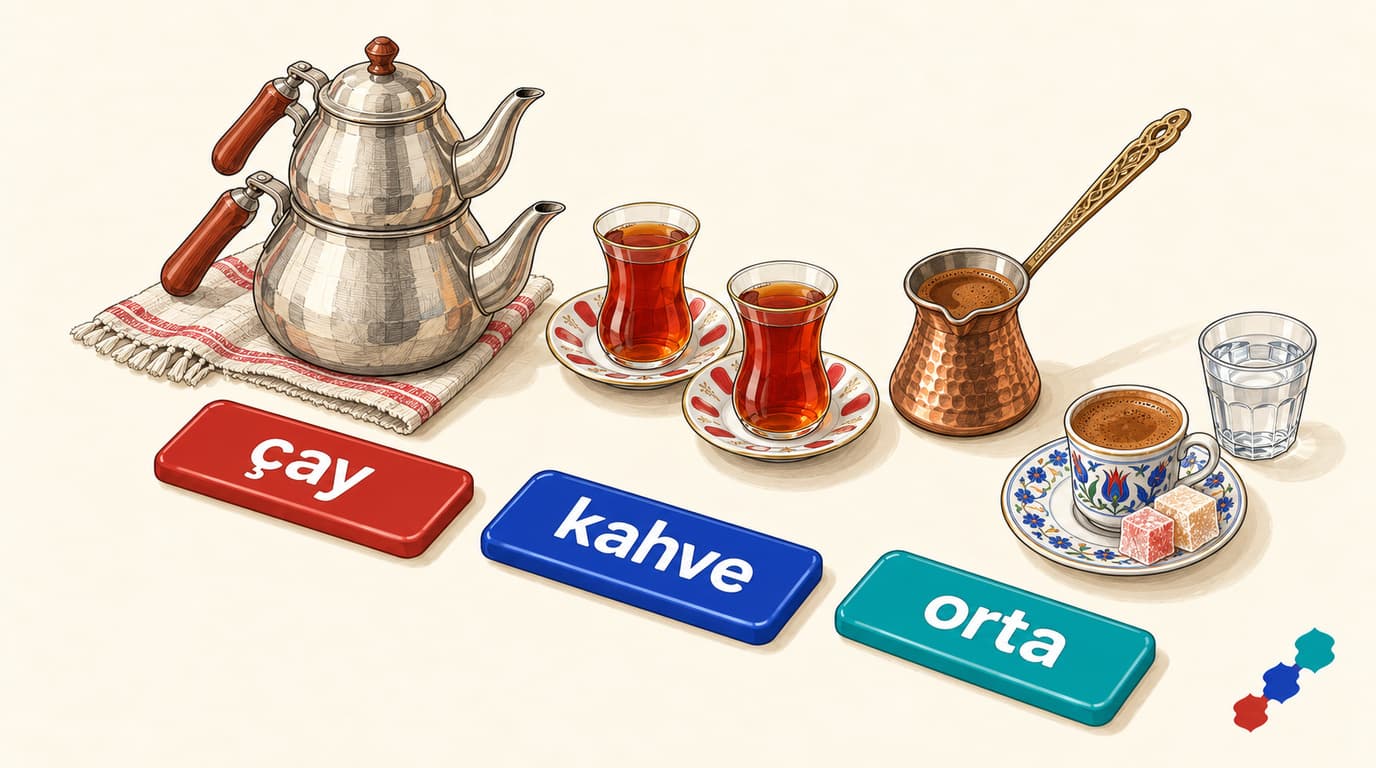
- ✓Tea is çay and coffee is kahve. Order with Bir çay, lütfen (a tea, please) or Bir orta kahve, lütfen (a medium-sweet coffee, please).
- ✓Turkish coffee is sweetened in the pot, so say how sweet you want it when you order: sade (no sugar), az şekerli (a little sugar), orta (medium) or şekerli (sweet).
- ✓Tea comes in a small tulip-shaped glass, açık (light) or demli (strong), and is offered all day: at home, in shops and at work, where a çaycı brings it from the çay ocağı.
- ✓After a Turkish coffee, friends often turn the cup over and read each other’s fortune in the grounds. This is kahve falı.
The short answer
Tea is çay and coffee is kahve. To order, name the drink and add lütfen, please: Bir çay, lütfen. Turkish coffee is sweetened while it brews, so the sugar goes into the order: Bir orta kahve, lütfen asks for a medium-sweet one. Tea is sweetened at the table with sugar cubes, so for tea you choose the strength instead: açık (light) or demli (strong).
The table below covers the orders you need, and every phrase in the tables has a listen button. To practise ordering out loud, the AI tutor has a conversation set in a coffee shop.
| Order | In English |
|---|---|
| Bir çay, lütfen. | A tea, please. |
| Açık olsun, lütfen. | Light, please. |
| Demli olsun, lütfen. | Strong, please. |
| Bir sade kahve, lütfen. | A Turkish coffee with no sugar, please. |
| Bir orta kahve, lütfen. | A medium-sweet Turkish coffee, please. |
| İki çay, bir kahve, lütfen. | Two teas and a coffee, please. |
| Çay var mı? | Do you have tea? |
Çay: light, strong and rabbit’s blood
Turkish tea is black tea brewed strong in a two-tier pot, the çaydanlık: water boils in the large kettle below while the tea steeps in the small pot on top, the demlik. Each glass is poured from both, strong tea first and then hot water, so every glass can be made lighter or stronger. Ask for açık for a light glass or demli for a strong one. The colour people aim for has a name: tavşankanı (often written tavşan kanı), rabbit’s blood, a clear deep red.
Tea comes in a small, slim-waisted glass on a saucer, with sugar cubes and a teaspoon and without milk. Şekerli means with sugar and şekersiz without. The word çay itself came into Turkish from Chinese. When you have had enough, lay the teaspoon across the top of the empty glass; the post on visiting a Turkish home covers that and the other customs at the table.
Tea is offered everywhere and all day. A shopkeeper may ask Çay içer misiniz? (Would you like some tea?) while you look around or wait for a repair. Offices, markets and workshops have a çay ocağı, a tea counter, where a tea server, the çaycı, brews tea and carries it round on a tray. A friend paying for the round says Çaylar benden, tea’s on me.
| Turkish | Meaning |
|---|---|
| açık | light (of tea) |
| demli | strong, well brewed |
| tavşankanı | rabbit’s blood: the ideal deep red |
| şekerli | with sugar |
| şekersiz | without sugar |
| Çay içer misiniz? | Would you like some tea? |
| Çaylar benden. | Tea’s on me. |
| çay ocağı | tea counter |
| çaycı | tea server |
Turkish coffee: sade, az şekerli, orta, şekerli
Turkish coffee, Türk kahvesi, is ground to a fine powder and brewed slowly with cold water, and sugar if wanted, in a small long-handled pot, the cezve. Because the sugar goes into the pot, the waiter or host asks before making it: Kahveniz nasıl olsun? (How would you like your coffee?). Answer with one of four sugar levels: sade (no sugar), az şekerli (a little sugar), orta (medium) or şekerli (sweet).
It comes in a small cup, the fincan, with a glass of water and often a piece of lokum, Turkish delight. Good Turkish coffee has a thick foam, köpük, and Köpüğü çok güzel (the foam is lovely) is a compliment to whoever made it. Sip it slowly and stop when you reach the thick grounds at the bottom, the telve: they are not for drinking. Kahve, cezve, fincan and lokum all came into Turkish from Arabic, lokum from rāḥat al-ḥulqūm.
Coffee has a more ceremonial place than tea. UNESCO lists Turkish coffee culture as intangible heritage and calls it a symbol of hospitality and friendship. A proverb says Bir fincan kahvenin kırk yıl hatırı vardır: a cup of coffee is remembered for forty years, meaning that a kindness, however small, is never forgotten.
| Turkish | Meaning |
|---|---|
| Türk kahvesi | Turkish coffee |
| Kahveniz nasıl olsun? | How would you like your coffee? |
| sade | no sugar |
| az şekerli | a little sugar |
| orta | medium sweet |
| şekerli | sweet |
| Köpüğü çok güzel. | The foam is lovely. |
| Bir fincan kahvenin kırk yıl hatırı vardır. | A cup of coffee is remembered for forty years. |
Kahve falı: reading the cup
When the coffee is finished, friends often play at kahve falı, coffee fortune-telling. You put the saucer on top of the cup, turn them over together and wait for the grounds to cool. Then a friend reads the shapes the telve has left inside the cup. To ask for a reading, say Falıma bakar mısın? (Will you read my fortune?).
For most people it is a social game more than a belief, and a reason to sit a little longer and talk. Fal, fortune, is another word from Arabic.
| Turkish | Meaning |
|---|---|
| kahve falı | coffee fortune-telling |
| Fincanını kapat. | Turn your cup over (literally close your cup). |
| Falıma bakar mısın? | Will you read my fortune? |
The grammar behind the orders
Çay mı, kahve mi? (Tea or coffee?) uses the question particle twice, once after each choice. It follows vowel harmony, mı after çay and mi after kahve, and it is written as a separate word. The lesson on the question particle covers it.
Kahveniz is kahve with -niz, your (plural, and the polite form for one person): Kahveniz nasıl olsun? Falım is fal with -ım, my. The lesson on possessive suffixes teaches the whole set.
Şekerli and şekersiz show a pair of suffixes worth learning early: -li means with and -siz means without. Sütlü kahve is coffee with milk. Both suffixes follow vowel harmony and have four forms each (-lı, -li, -lu, -lü and -sız, -siz, -suz, -süz), so şeker takes -li and -siz while süt takes -lü.
| Turkish | How it is built | In English |
|---|---|---|
| Çay mı, kahve mi? | The question particle after each choice | Tea or coffee? |
| kahveniz | kahve with -niz, your (plural or polite) | your coffee |
| falım | fal with -ım, my | my fortune |
| şekersiz | şeker with -siz, without | without sugar |
| sütlü kahve | süt with -lü, with | coffee with milk |
How do you say tea and coffee in Turkish?
Tea is çay and coffee is kahve. Çay came into Turkish from Chinese and kahve from Arabic. Turkish coffee is Türk kahvesi, and to ask for one, say Bir Türk kahvesi, lütfen.
What does tavşankanı mean?
Rabbit’s blood. It names the colour of well-brewed tea, a clear deep red, neither pale nor too dark: the glass a good host aims for.
How sweet is orta?
Medium: clearly sweet, but not syrupy. If you are unsure, orta is a safe middle choice; sade has no sugar at all and şekerli is the sweetest.
Do you drink the grounds in Turkish coffee?
No. Let the cup rest a minute so the grounds settle, sip from the top and stop when you reach the thick layer at the bottom, the telve. That layer is what kahve falı reads.
Sources
Lessons on this topic
- Turkish Question Particle: mı, mi, mu, mü
- Turkish Possessive Suffixes: -im, -in, -i
- Var and Yok in Turkish: There Is, There Is Not
Practice What You Just Learned
Put these structural insights into immediate muscle memory with interactive drills and spaced repetition.