Key Takeaways
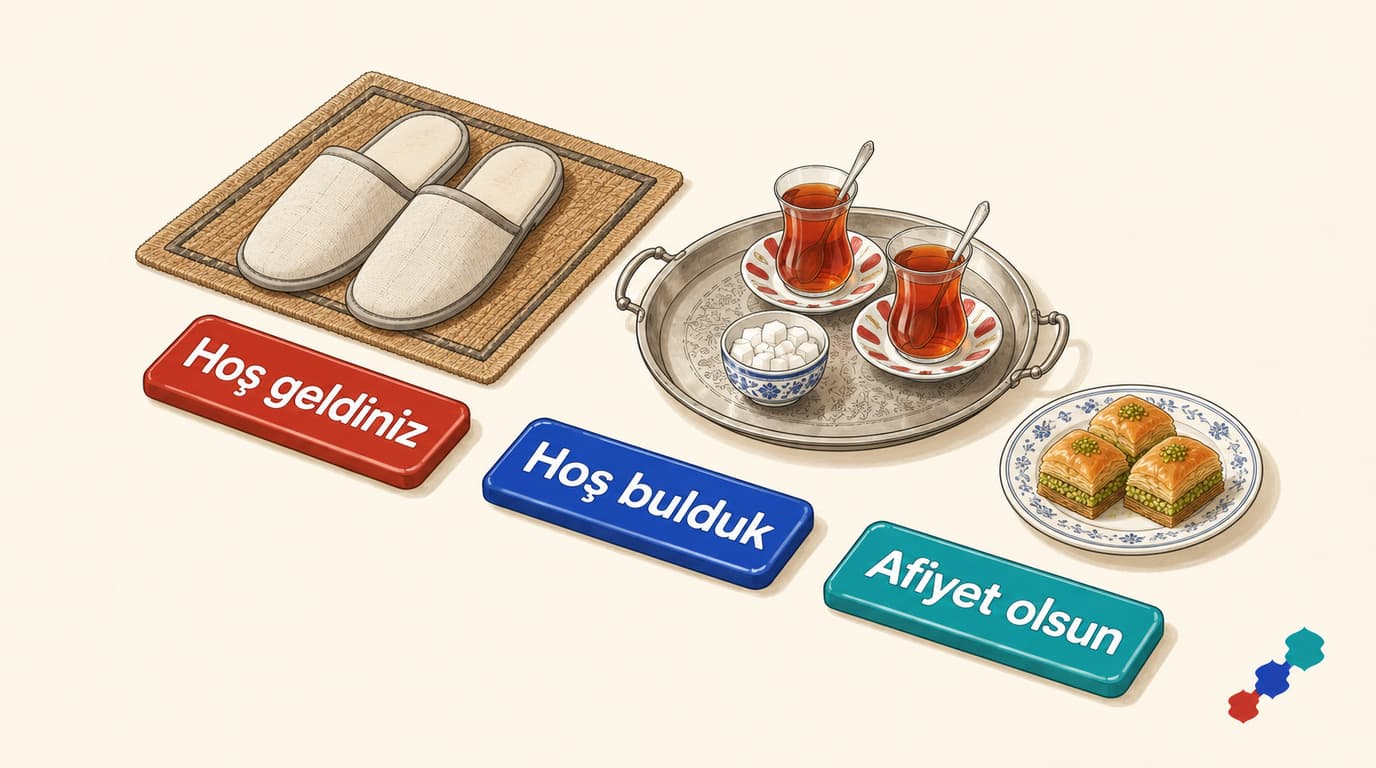
- ✓The host greets you with Hoş geldiniz (welcome) and you answer Hoş bulduk. Much of a Turkish visit runs on pairs like this: a set phrase and its set reply.
- ✓Shoes come off at the door, and the host will usually offer slippers. Guests usually bring something small to share, such as sweets or flowers.
- ✓When food or tea is served the host says Afiyet olsun (enjoy your meal). After eating, thank the cook with Ellerinize sağlık (health to your hands), and the cook answers Afiyet olsun.
- ✓To leave, say Bize müsaade (with your permission). The person leaving says Hoşça kalın and the one staying answers Güle güle.
The short answer
A visit to a Turkish home runs on pairs of set phrases: one person says the first half and the other answers with the second. At the door the host says Hoş geldiniz (welcome) and you say Hoş bulduk. When food is served you hear Afiyet olsun (enjoy your meal), and after eating you thank the cook with Ellerinize sağlık. When you leave you say Hoşça kalın (stay well) and the host answers Güle güle (go with a smile).
Knowing both halves of each pair is most of the etiquette. The table below is the whole visit at a glance; the sections after it add the customs and the phrases around them. Every phrase in the tables has a listen button.
| Phrase | Reply | Who says it, and when |
|---|---|---|
| Hoş geldiniz. | Hoş bulduk. | The host, at the door |
| Afiyet olsun. | Teşekkürler. | The host, when food or tea is served |
| Ellerinize sağlık. | Afiyet olsun. | You, to the cook, after eating |
| Bize müsaade. | Daha erken! | You, when it is time to go |
| Hoşça kalın. | Güle güle. | You, at the door as you leave |
At the door: hoş geldiniz, buyurun and slippers
The host opens the door with Hoş geldiniz, welcome, literally “you came pleasantly”. The answer is Hoş bulduk, “we found it pleasant”, and it is said with bulduk, we, even by a guest who comes alone. It is the reply everyone expects, so learn it as one piece with the greeting. A host who knows you well may use the informal Hoş geldin; the answer stays Hoş bulduk. The word for guest, misafir, came into Turkish from the Arabic musāfir, traveller.
Next comes Buyurun, please. It does a lot of work in a Turkish home: it invites you in, offers you a seat and hands you a glass of tea. Shoes come off just inside the door, and the host will usually offer you a pair of slippers, terlik.
Guests usually bring something small to share: a box of baklava or other sweets, chocolates or flowers. Handing it over, you might say Küçük bir şey getirdik (we brought a little something). The host will protest with Ne gerek vardı? (there was no need) or Zahmet ettiniz (you shouldn’t have gone to the trouble). Both are a thank you, not a complaint.
| Phrase | Meaning | Who says it |
|---|---|---|
| Hoş geldiniz. | Welcome (literally you came pleasantly) | The host |
| Hoş geldin. | Welcome (informal) | The host, to a friend or a child |
| Hoş bulduk. | Glad to be here (literally we found it pleasant) | The guest |
| Buyurun, içeri geçin. | Please, come in | The host |
| Terlik ister misiniz? | Would you like slippers? | The host |
| Küçük bir şey getirdik. | We brought a little something | The guest, with a gift |
| Ne gerek vardı? | There was no need! | The host, taking the gift |
| Zahmet ettiniz. | You shouldn’t have gone to the trouble (a thank you) | The host, taking the gift |
Tea and the meal: afiyet olsun and ellerinize sağlık
Tea usually comes soon after you sit down, in small tulip-shaped glasses: Çay içer misiniz? (Will you have tea?). When food or tea is served, the host usually says Afiyet olsun, enjoy your meal. Afiyet comes from the Arabic ʿāfiya, health and wellbeing, so the phrase is literally “may it be health”. Anyone can say it to someone who is eating; the answer is Teşekkürler, thanks.
After eating, thank whoever cooked with Ellerinize sağlık, health to your hands. Turks say it to thank anyone for work done with their hands, and above all for food. The cook answers Afiyet olsun. Eline sağlık is the same phrase for someone you call sen. Praise for the food helps too: Çok lezzetli olmuş (this turned out really delicious).
Expect to be offered more, more than once. A host who hears no the first time will often offer again, because a first refusal can be politeness. When you really have had enough, say Teşekkürler, doydum (thanks, I’m full), and say it again kindly if the host insists. With tea, a teaspoon laid across the top of the empty glass is a common way to say no more.
| Phrase | Meaning | Who says it |
|---|---|---|
| Çay içer misiniz? | Will you have tea? | The host |
| Afiyet olsun. | Enjoy your meal (literally may it be health) | The host, or anyone, to someone eating |
| Ellerinize sağlık. | Thank you for the meal (literally health to your hands) | The guest, to the cook |
| Eline sağlık. | The same, to someone you call sen | The guest, to the cook |
| Çok lezzetli olmuş. | This turned out really delicious | The guest |
| Bir çay daha? | Another tea? | The host |
| Teşekkürler, doydum. | Thanks, I’m full | The guest |
Leaving: bize müsaade, hoşça kalın, güle güle
Leaving takes a few rounds. Start with Bize müsaade, with your permission, meaning it is time for us to go. Müsaade is another Arabic word, musāʿada, which means help in Arabic but permission in Turkish. The host is expected to object, Daha erken! (It’s still early!), and a Turkish goodbye often goes on for a while at the door.
At the door the host may thank you for coming with Ayağınıza sağlık, health to your feet. Then the two halves of goodbye: the person leaving says Hoşça kalın, stay well, and the one staying answers Güle güle, go with a smile. They are not interchangeable, and swapping them sounds odd. The host will often add Yine bekleriz, we hope to see you again.
To practise the whole visit out loud, the AI tutor has a conversation set in a Turkish home.
| Phrase | Meaning | Who says it |
|---|---|---|
| Bize müsaade. | With your permission, we’ll be going | The guest |
| Daha erken! | It’s still early! | The host |
| Ayağınıza sağlık. | Thank you for coming (literally health to your feet) | The host |
| Yine bekleriz. | Come again (literally we will expect you again) | The host |
| Hoşça kalın. | Goodbye (literally stay well) | The person leaving |
| Güle güle. | Goodbye (literally go smiling) | The person staying |
The grammar behind the phrases
Most of these phrases come in two forms: a short one for sen, the informal you, and a longer one for siz, the polite you, or for several people. Hoş geldin becomes Hoş geldiniz, eline (to your hand) becomes ellerinize (to your hands, with -ler for the plural), hoşça kal becomes hoşça kalın. Use the long forms with a host you don’t know well. The lesson on personal pronouns explains sen and siz.
Buyurun and oturun (sit down) are polite commands: the verb with -(y)In added. Afiyet olsun uses the third-person form -sIn, “let it be”, the same ending as in kolay gelsin and geçmiş olsun. The lesson on the imperative teaches both.
Geldiniz and bulduk are in the past tense, -dI: “you came”, “we found”. The welcome is about what has just happened: you came, and we found it pleasant.
| To sen | To siz | Meaning |
|---|---|---|
| Hoş geldin. | Hoş geldiniz. | Welcome |
| Eline sağlık. | Ellerinize sağlık. | Thank you for the meal |
| Buyur. | Buyurun. | Please (come in, sit down, here you are) |
| Otur. | Oturun. | Sit down |
| Hoşça kal. | Hoşça kalın. | Goodbye, said by the person leaving |
What do you say back to hoş geldiniz?
Hoş bulduk. It is the fixed reply, said with bulduk (we found) even when you come alone, and it answers the informal Hoş geldin too.
Do I have to take my shoes off in a Turkish home?
Expect to. Shoes come off at the door in most Turkish homes, and the host will usually offer slippers. Take them off without waiting to be asked; if the host insists you keep them on, you can.
What should I bring when I visit a Turkish family?
Something small to share: a box of baklava, lokum or other sweets from a pastry shop, chocolates, or flowers. Alcohol is best left out unless you know the family drinks it.
How do I politely refuse more food?
Say Teşekkürler, doydum (thanks, I’m full), and add Ellerinize sağlık to thank the cook. Expect to be asked again, since a first no is often taken as politeness, and repeat it kindly. With tea, lay the teaspoon across the top of the empty glass.
Sources
Lessons on this topic
- Turkish Greetings and Introductions
- Turkish Imperative: Commands and Requests
- Turkish Personal Pronouns: ben, sen, o
Practice What You Just Learned
Put these structural insights into immediate muscle memory with interactive drills and spaced repetition.