Key Takeaways
- ✓Turkish grammar is learned in a dependency order: vowel harmony and consonant change first, because every suffix after them obeys those two rules.
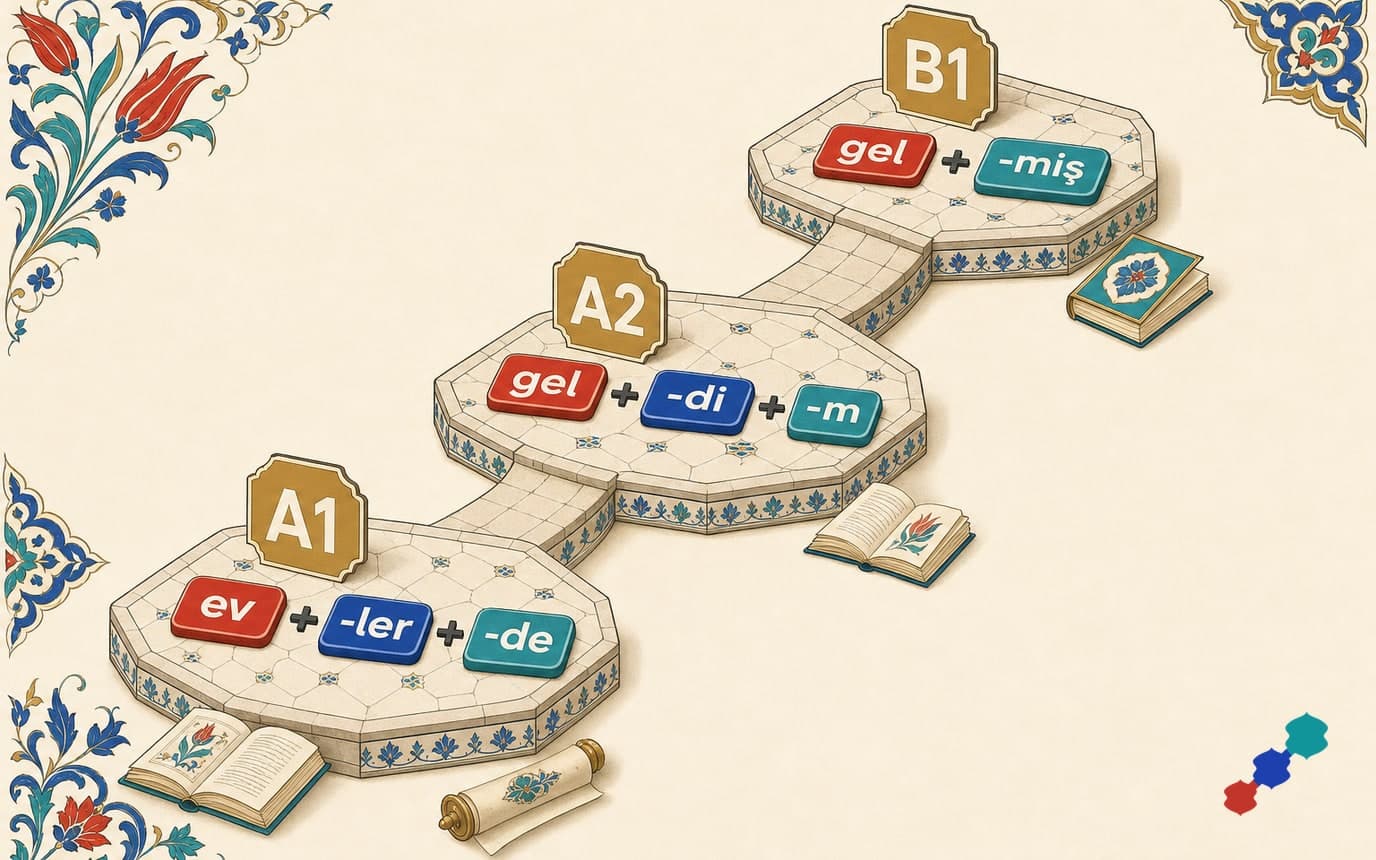
- ✓A1 is the sound rules, the copula, the four core cases, the present continuous and possession; A2 is tense, modality, the genitive, and the verb turned into a noun or adjective.
- ✓B1 opens with the evidential past, the conditional, the passive and reported speech: 4 topics today, growing.
- ✓Dilsever teaches all 39 topics as lesson, practice block and mastery check; 36 of them carry a one-line cheat sheet, and every topic links to the drill that trains it.
Why the order matters more than the list
Most grammar lists for Turkish are alphabetical or textbook-shaped, and neither tells you what to learn first. Turkish grammar has a dependency graph. Every suffix in the language changes shape according to the last vowel of the word it joins, and many change again when the word ends in a hard consonant. Learn the plural before vowel harmony and you memorise two endings; learn harmony first and you own every ending that follows.
The same holds for the copula. The endings that say "I am a doctor" are the same personal endings that later appear on every tense, so the copula is taught before any verb form. Dilsever orders its 39 topics along these dependencies rather than by frequency or by chapter, and the order below is the order the app presents them in.
A1: the sound rules and the case system
A1 opens with greetings, the pronouns and the demonstratives, then spends two topics on sound alone: vowel harmony, and the consonant changes that turn kitap into kitabı and kitapta. Only then does the first suffix arrive. The copula and the question particle follow, then negation and var/yok, so a learner can build a full sentence about existence and identity before touching a verb.
The middle of A1 is the case system: plural, locative, dative, ablative and accusative, one topic each, in the order a learner meets them in speech. Present continuous comes late on purpose. By the time -iyor appears, the personal endings are already familiar from the copula, the buffer vowel is familiar from the cases, and the tense is one new piece rather than four.
A1 closes with the imperative, ile, and possession. Possession is last because it combines everything before it: harmony, a buffer consonant, and the case endings that stack on top of it. 18 topics in all.
A2: time and modality
A2 is where the verb grows. The seen past (-di) comes first because it is the most regular tense in the language, then the future (-ecek), the aorist (-er/-ir) with its habits and promises, and the past continuous. Each tense reuses the personal endings from A1, so each is one suffix and one harmony decision.
Then modality: necessity (-meli), ability (-ebil), wanting (-mek istemek) and external obligation (-mek zorunda). Comparison with daha and en sits between that group and the genitive. These are taught as a group because they answer the same question, how strongly, and a learner who sees them side by side stops confusing gelmeliyim with gitmek zorundayım.
A2 closes by turning the verb into other things: the genitive and noun compounds, verbal nouns, the -en participle, the -erek and -ken converbs, the -den önce / -den sonra frame, and -lı / -sız for having and lacking. 17 topics, and the point where Turkish sentences start to nest.
B1 and beyond: what changes
At B1 the grammar stops adding forms and starts adding stance. The evidential past (-miş) marks what you heard rather than saw. The conditional (-se) and the passive (-il/-in) let a sentence leave out its doer or its certainty. Reported speech (-dığını söyledi) folds one sentence inside another with the possessive doing the work of "that".
Dilsever ships 4 topics at B1 today, deepened with fuller explanations, polarity tables and pitfalls, and the level is growing. The vocabulary packs for B1 are still in editing, which is why the public levels rail says so, and why the grammar curriculum is ahead of the word bank.
How a list becomes practice
A list of 39 topics is a syllabus, not a course. In Dilsever each topic is a lesson with form tables and examples, then a practice block, then a mastery check that has to be passed for the topic to count. 36 of them also carry a cheat sheet: the rule reduced to a few lines, folded until the learner asks for it, and saved to their notes in one tap.
Every topic links to the drill that trains it. A suffix topic opens its Suffix Lab drill, a tense topic opens Conjugation Lab, and the topics with no suffix of their own get a cloze check built from their own examples. The Home screen shows the next unmastered topic, so the path above is also the path the app walks you along.
See all 39 topics
The full curriculum, by level and in order, is public at www.dilsever.com/curriculum. Every topic on it is inside the app with its lesson, practice and check.
Practice What You Just Learned
Put these structural insights into immediate muscle memory with interactive drills and spaced repetition.