Key Takeaways
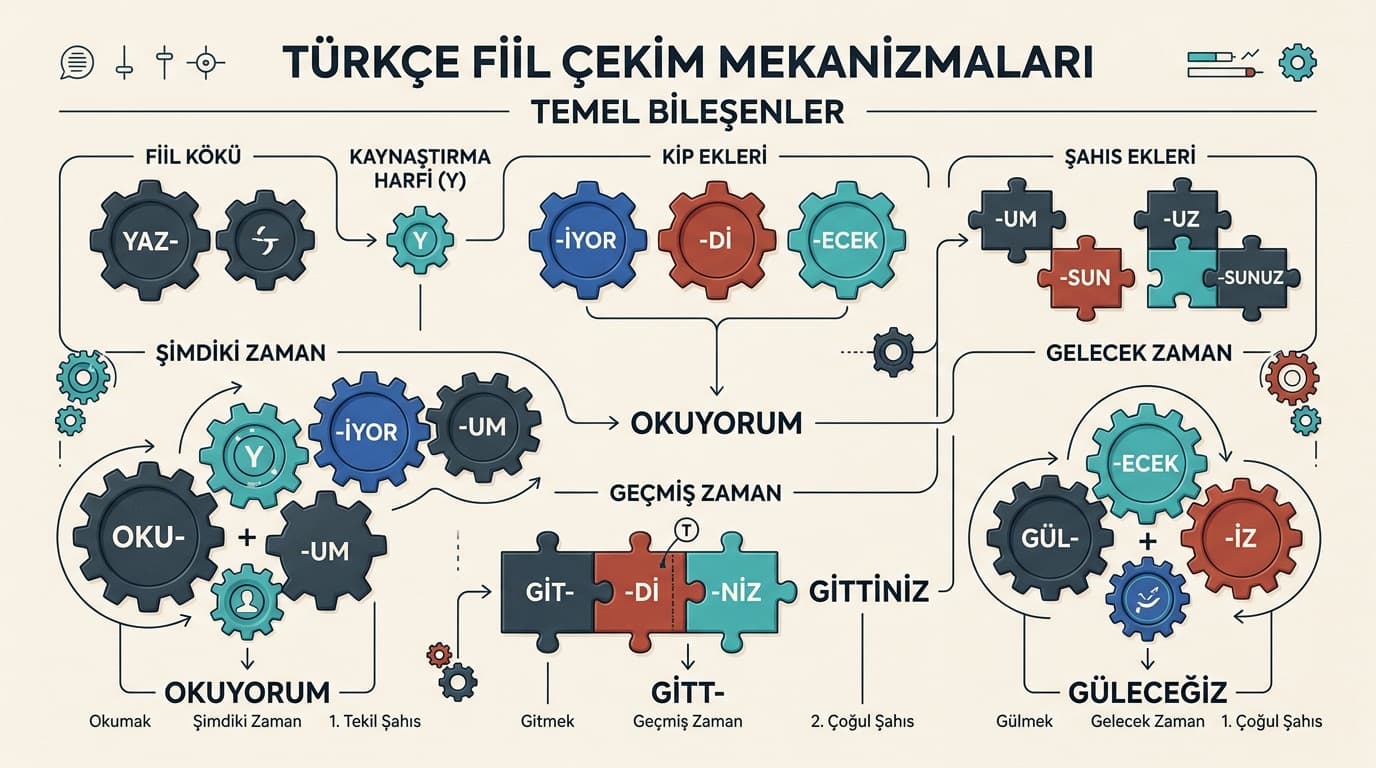
- ✓Every Turkish verb begins with an infinitive in -mak or -mek. Dropping this ending reveals the verb stem.
- ✓The conjugation formula is: Stem + Negative (optional) + Tense Suffix + Personal Ending.
- ✓Buffer letter "y" protects two adjacent vowels from colliding.
- ✓The Present Continuous (-iyor) is the most versatile and essential tense for beginners.
The Universal Turkish Verb Formula
Turkish verb conjugation is renowned among linguists for its extraordinary regularity. With only one truly irregular verb in the entire language (olmak / to be in certain archaic forms), every verb follows one universal assembly formula:
Verb Stem + [Negation -me/-ma] + Tense Suffix + Personal Ending
For example: gel (come) + me (not) + y (buffer) + ecek (will) + sin (you) = gelmeyeceksin (you will not come).
1. The Present Continuous Tense (-iyor / -ıyor / -uyor / -üyor)
The "-iyor" tense represents actions happening right now ("I am coming") as well as general habits and scheduled future plans in conversational Turkish.
Rule: If the verb stem ends in a consonant, attach the appropriate 4-way harmonic vowel before -yor (gel-i-yor, bak-ı-yor, oku-yor, gör-ü-yor).
If the verb stem ends in an open vowel (a or e), the vowel narrows to match harmony: başla- + -iyor = başlıyor (she is starting).
2. The Definite Past Tense (-di / -dı / -du / -dü / -ti / -tı / -tu / -tü)
Used for completed actions that the speaker witnessed firsthand or knows with direct certainty.
Consonant hardening rule: If the verb stem ends in one of the 8 voiceless consonants (F, S, T, K, Ç, Ş, H, P: remembered as "Fıstıkçı Şahap"), the "d" hardens into "t": git- + -ti = gitti (he went).
3. The Future Tense (-ecek / -acak)
Expresses definite future actions and promises. Governed by 2-way vowel harmony (A-type):
• Front vowels (e, i, ö, ü) take -ecek: gelecek (he will come), görecek (she will see).
• Back vowels (a, ı, o, u) take -acak: yapacak (he will do), kalacak (she will stay).
Soft G (ğ) mutation: When a vowel-initial personal ending follows (like 1st person singular -im), the "k" softens into "ğ": yapacağım (I will do: pronounced "yapıcam" in spoken Turkish).
The Buffer Letter Y
If a verb stem ends in a vowel, always insert the buffer letter "y" before vowel-initial tenses: oku- + -y- + -acak = okuyacak (he will read).
Mastering Conjugations in Dilsever’s Conjugation Lab
Memorizing verb tables on paper can feel dry, but practicing them in context with real audio develops lightning-fast reflexes.
In Dilsever’s Conjugation Lab, you can practice multi-tense drills, toggle polarity (positive, negative, question), and inspect full personal paradigm grids for every essential Turkish verb.
Practice What You Just Learned
Test your Turkish morphology intuition and verb conjugations with instant feedback in Dilsever’s dedicated labs.