Key Takeaways
- ✓How are you in Turkish is nasılsın to a friend and nasılsınız to someone older, someone you do not know well, or a group.
- ✓The usual answer is iyiyim, teşekkür ederim, I’m fine, thank you. Then ask back: sen nasılsın or siz nasılsınız.
- ✓Naber, short for ne haber, is the casual what’s up. Keep it for friends.
- ✓İyi misin asks are you all right. Friends add it after nasılsın, but on its own it often means that something seems wrong.
The short answer
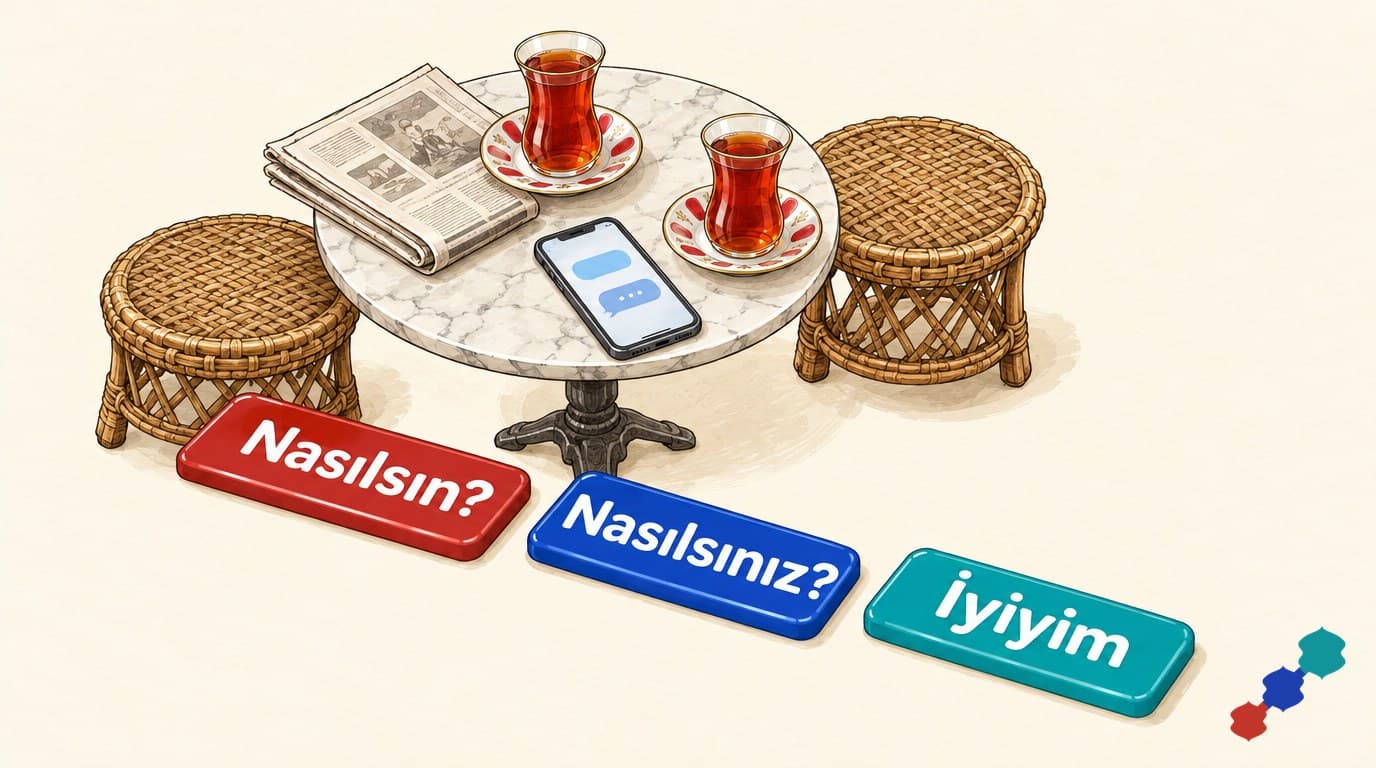
How are you in Turkish is nasılsın? (NAH-suhl-suhn) to a friend, and nasılsınız? (NAH-suhl-suh-nuhz) to someone older, someone you do not know well, or more than one person. The usual answer is iyiyim, teşekkür ederim, I’m fine, thank you. Then ask back with sen nasılsın? or siz nasılsınız?
That exchange happens many times a day, and it is often closer to a greeting than to a real question. The sections below add the casual versions, a full range of answers and the grammar behind them. Every phrase in the tables has a listen button.
| Question | Say it | In English | Who with |
|---|---|---|---|
| Nasılsın? | NAH-suhl-suhn | How are you? | Friends, family, children |
| Nasılsınız? | NAH-suhl-suh-nuhz | How are you? (polite) | Elders, strangers, clients, groups |
| Naber? | NAH-ber | What's up? | Close friends |
| Ne var ne yok? | neh VAHR neh YOHK | What's new? | People you know and have not seen for a while |
Nasılsın or nasılsınız: formal and informal
Both come from nasıl, how, plus an ending that means you. There is no separate word for are: -sın is you (one person, informal) and -sınız is you (polite or plural). So nasılsın is literally how-you. The vowel in the ending is ı because the last vowel of nasıl is ı, which is vowel harmony at work.
Use nasılsınız with a teacher, a doctor, a shopkeeper, an older neighbour or your partner’s parents, and with anyone you call Bey or Hanım. Use nasılsın with friends, brothers and sisters, and children. If you are not sure, start with nasılsınız. It is the safe choice, and the other person may tell you when to switch: Bana sen diyebilirsin, you can call me sen.
Add a name or a title and the question sounds warmer: Nasılsınız hocam? to a teacher, or Zeynep Hanım, nasılsınız? to a neighbour. The same split between sen and siz runs through every question below.
| To a friend | Polite, or to a group | In English |
|---|---|---|
| Nasılsın? | Nasılsınız? | How are you? |
| Sen nasılsın? | Siz nasılsınız? | And how are you? |
| İyi misin? | İyi misiniz? | Are you all right? |
| Ne yapıyorsun? | Ne yapıyorsunuz? | What are you up to? |
| Ailen nasıl? | Aileniz nasıl? | How is your family? |
| İşlerin nasıl? | İşleriniz nasıl? | How is work going? |
Naber and other casual questions
Naber is ne haber, what news, worn down in fast speech. Haber is an Arabic loan meaning news. It is the Turkish what’s up: quick, friendly and not meant for your friend’s grandmother. Nasıl gidiyor? means how is it going, and it fits colleagues as well as friends. Ne var ne yok? asks what is there and what isn’t, a warm way to catch up with someone you have not seen for a while.
The answers to these are as loose as the questions. Nobody expects a full report, and a light İyi, senden naber? is enough to send the ball back. Senden means from you, so the reply literally asks for the news from your side.
| Question | Answer | In English |
|---|---|---|
| Naber? | İyi, senden naber? | What’s up? Good, what about you? |
| Ne haber? | İyilik, senden? | What’s new? All good, you? |
| Ne var ne yok? | İyilik, sağlık | What’s new? All good and healthy. |
| Nasıl gidiyor? | İyi gidiyor, teşekkürler. | How’s it going? It’s going well, thanks. |
| Ne yapıyorsun? | Hiç, evdeyim. | What are you up to? Nothing, I’m at home. |
How to answer: from great to not so good
İyiyim means I’m fine. It is iyi, good, with -im, I am. A y slips in because Turkish does not let the two vowels touch, the same buffer you will meet across the grammar. Fena değil, not bad, and eh işte, so-so, are honest middle answers. Çok şükür, thank God, is everywhere and is not reserved for the very devout: people of all ages use it to say that all is well.
The polite habit matters more than the answer. Give a short reply, add a thank-you, and ask back. To a friend that is İyiyim, sen nasılsın? and to anyone else it is İyiyim, teşekkür ederim. Siz nasılsınız? If you are not well, say so: people will reply geçmiş olsun, may it pass.
| Answer | In English | When |
|---|---|---|
| Çok iyiyim. | I’m very well. | When things are going well |
| İyiyim, teşekkür ederim. | I’m fine, thank you. | The standard answer |
| Çok şükür, iyiyim. | I’m well, thank God. | With elders and neighbours, and in general |
| Fena değil | Not bad | An honest middle |
| Eh işte | So-so | Friends, when nothing is great |
| Biraz yorgunum. | I’m a bit tired. | A long day |
| Pek iyi değilim. | I’m not very well. | When you want to say something is wrong |
Asking about someone else
Asking after someone’s family is part of good manners in Turkish, and it often follows the first question straight away. Now nasıl stands alone, with no ending, because the person is he or she: Annen nasıl? How is your mother? Çocuklar nasıl? How are the children? Evdekiler nasıl? How is everyone at home? To send your regards, say Annene selam söyle, say hello to your mother.
How are you in everyday scenes
These exchanges use the phrases above at the length real people use them. Listen for how much shorter the friendly lines are than the polite ones.
| Where | Question | Answer | In English |
|---|---|---|---|
| Two friends meet | Selam, nasılsın? | İyiyim, sen nasılsın? | Hi, how are you? I’m fine, how are you? |
| A colleague on Monday | Günaydın, nasıl gidiyor? | İyi gidiyor, teşekkürler. | Good morning, how’s it going? It’s going well, thanks. |
| Your teacher | Merhaba hocam, nasılsınız? | İyiyim, teşekkür ederim. Siz nasılsınız? | Hello, teacher, how are you? I’m fine, thank you. And you? |
| An older neighbour | Ayşe Teyze, nasılsınız? | Çok şükür, iyiyim. Sen nasılsın? | Ayşe Teyze, how are you? Thank God, I’m well. How are you? |
| A friend looks worn out | İyi misin? Yorgun görünüyorsun. | Biraz yorgunum, dün geç yattım. | Are you all right? You look tired. I’m a bit tired, I went to bed late last night. |
How to pronounce nasılsın
Nasılsın has three syllables, na-sıl-sın, with the stress on the first. The key sound is ı, the undotted i, a short vowel like the a in ago. Both of its ı letters sound the same. Do not say NAH-sill-sin with the i of sit: the dot matters in Turkish, and ı and i are two different letters. İyiyim starts with the capital dotted İ, and all its vowels are the clear ee sound.
What does nasılsın mean?
It means how are you, said to one person you know well. It is a single word in Turkish: nasıl, how, plus -sın, you. The polite or plural version is nasılsınız.
How do you say I am fine in Turkish?
Say iyiyim. Add teşekkür ederim, or the friendly sağ ol, and you have the most common answer in the language. Ben iyiyim, with the pronoun, is correct too, but you only need it when you want to contrast yourself with someone else.
Is naber rude?
No, but it is casual. Between friends it sounds natural and warm. To a stranger, a client or an older person it sounds too familiar, so use nasılsınız there.
What is the difference between nasılsın and iyi misin?
Nasılsın is the open, everyday how are you. İyi misin is a yes-or-no question, are you all right, built with the question particle. You ask it when someone looks unwell or upset, or after a fall or a bad moment, and friends also add it after a greeting: Nasılsın, iyi misin?
Sources
Lessons on this topic
- Turkish Greetings and Introductions
- The Verb To Be in Turkish: -im, -sin, -dir
- Turkish Personal Pronouns: ben, sen, o
Practice What You Just Learned
Put these structural insights into immediate muscle memory with interactive drills and spaced repetition.