Key Takeaways
- ✓Thank you in Turkish is teşekkür ederim, polite and safe with anyone. Teşekkürler is a little lighter.
- ✓With friends and family the natural word is sağ ol, literally be healthy. Sağ olun is the polite or plural form.
- ✓The standard reply is rica ederim. Bir şey değil and ne demek are lighter ways to say it was nothing.
- ✓Hoş geldiniz means welcome to someone arriving. It is never the reply to a thank-you.
The short answer
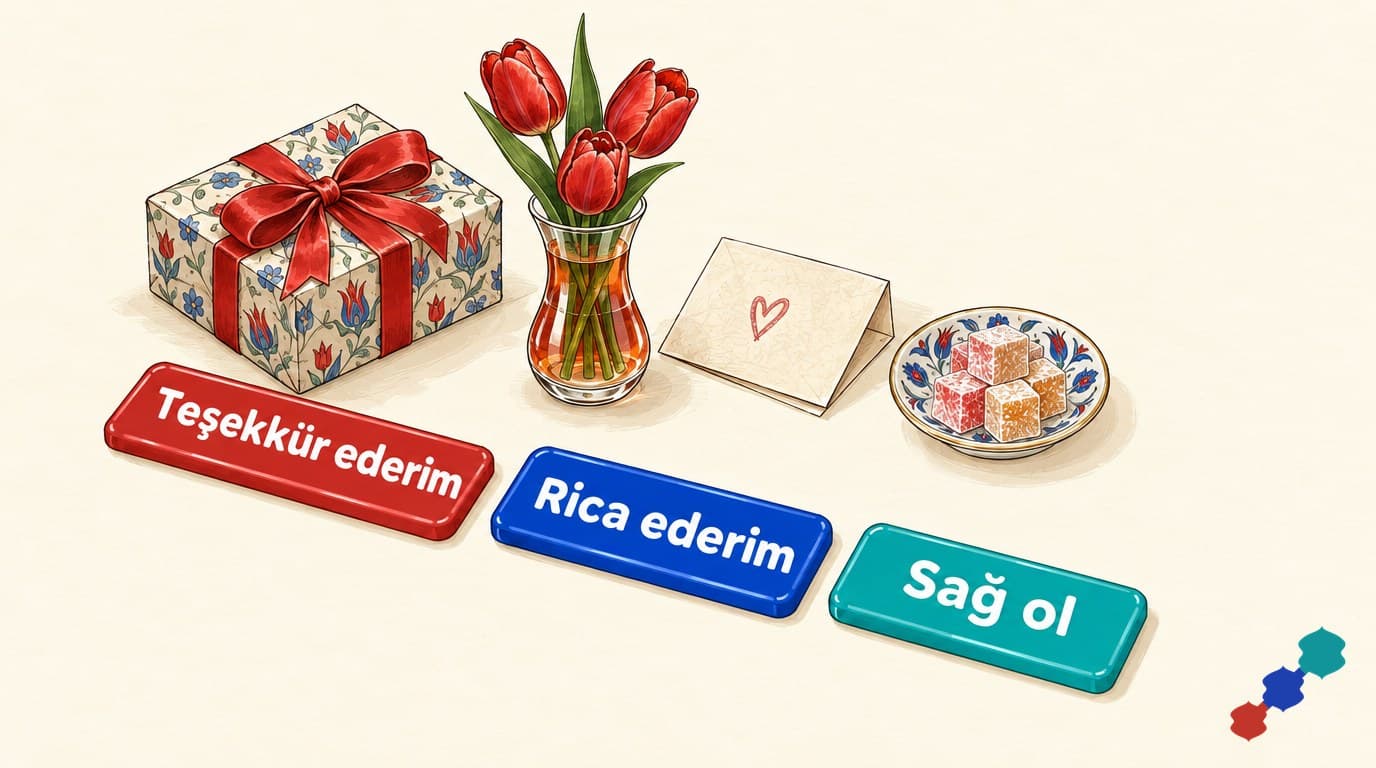
Thank you in Turkish is teşekkür ederim (teh-shek-KÜR eh-DEH-reem). It is polite and safe with anyone, from a bus driver to a professor. Teşekkürler (thanks) is a little lighter. With friends and family, the natural word is sağ ol. When someone thanks you, the usual reply is rica ederim, you’re welcome.
Add çok, very, for more warmth: çok teşekkür ederim means thank you very much. Each table below has listen buttons, and the say-it columns are a rough guide to the sounds.
| Phrase | Say it | In English | When |
|---|---|---|---|
| Çok teşekkür ederim | CHOHK teh-shek-KÜR eh-DEH-reem | Thank you very much | When someone has really helped you |
| Teşekkür ederim | teh-shek-KÜR eh-DEH-reem | Thank you | With anyone, at any time |
| Çok teşekkürler | CHOHK teh-shek-kür-LEHR | Thanks a lot | A warm thanks that is not stiff |
| Teşekkürler | teh-shek-kür-LEHR | Thanks | Colleagues, shop staff, messages |
What teşekkür ederim really says
The phrase has two parts. Teşekkür is a noun from Arabic, meaning thanks, and ederim is I do, from etmek, to do. Word for word, you are saying I do thanks. Change the ending and the person changes too: teşekkür ederiz means we thank you, and it is what you often hear from a shop or a restaurant as you pay.
To say what you are thankful for, put için, for, after the thing: Yardımınız için teşekkür ederim, thank you for your help. To a friend, the possessive changes: Yardımın için teşekkür ederim. To stress that the thanks is for this person, name them in the dative: Size çok teşekkür ederim.
| Turkish | In English | When |
|---|---|---|
| Yardımınız için teşekkür ederim. | Thank you for your help. | To someone you address politely |
| Yardımın için teşekkür ederim. | Thanks for your help. | To a friend |
| Her şey için teşekkür ederim. | Thank you for everything. | At the end of a stay or a course |
| İlginiz için teşekkür ederim. | Thank you for your attention. | In emails and at the end of a talk |
Sağ ol: the friendly thank you
Sağ ol means be healthy or be alive: sağ is healthy, and ol is the command form of olmak, to be. It is the thank-you you will hear most between friends, relatives and neighbours, and it sounds warmer than teşekkürler. The ğ is silent and only lengthens the vowel, so it comes out close to SAH-ohl.
Because ol speaks to one person you know well, the polite and plural form adds -un: sağ olun. The same split runs through most friendly thanks, as the table shows. If you address someone as siz, use the right-hand column.
| To a friend | Polite, or to a group | In English |
|---|---|---|
| Sağ ol | Sağ olun | Thanks |
| Eline sağlık | Ellerinize sağlık | Health to your hands |
| Çok naziksin | Çok naziksiniz | You are very kind |
| Zahmet ettin | Zahmet ettiniz | You went to so much trouble |
Thanks that fit the moment
Turkish has set phrases for particular kinds of gratitude. After a meal, thank the cook with eline sağlık or ellerinize sağlık, health to your hands, and the cook answers afiyet olsun. The same phrase thanks anyone who made or repaired something for you. When someone has done you a real kindness, Allah razı olsun, may God be pleased with you, is deep and heartfelt, and people of every age use it. A common reply is hepimizden, with all of us.
Eyvallah is a relaxed thanks, heard mostly between men in shops and on the street. At the far end, size minnettarım, I am indebted to you, is strong and rather literary, so save it for letters and big moments.
| Phrase | Reply | In English | When |
|---|---|---|---|
| Eline sağlık | Afiyet olsun | Health to your hands | After a meal, or for anything made by hand |
| Allah razı olsun | Hepimizden | May God be pleased with you | For a real kindness |
| Teşekkür ederiz | Ben teşekkür ederim | We thank you | From a shop or a restaurant as you pay |
What to reply to thank you
Rica ederim is the standard, polite reply. Rica means request, so it literally says I request, in the sense of please, there is no need. Bir şey değil, it’s nothing, and önemli değil, it’s not important, are lighter. Ne demek is friendly and common. It uses the same words as the question what does it mean, so here it comes out like what are you saying, of course.
Estağfurullah needs a note. It comes from the Arabic for I seek God’s forgiveness, but in Turkish it is a modest not at all, said when someone thanks or praises you. Between friends, when someone says sağ ol, the natural answer is sen de sağ ol, you too.
| Reply | Say it | In English | Register |
|---|---|---|---|
| Rica ederim | ree-JAH eh-DEH-reem | You’re welcome | Polite, for anyone |
| Bir şey değil | bir SHAY deh-EEL | It’s nothing | Everyday |
| Ne demek | NEH deh-mek | Don’t mention it | Warm and friendly |
| Önemli değil | ö-nem-LEE deh-EEL | It’s not important | Everyday |
| Ben teşekkür ederim | ben teh-shek-KÜR eh-DEH-reem | It is I who should thank you | When you owe thanks too, as a shopkeeper does |
| Estağfurullah | es-TAH-foo-roo-lah | Not at all | Modest, also to a compliment |
Thank you in everyday scenes
Here is how the phrases and their replies sound together. Notice that a reply often adds a little more, a wish or a kind word, so the moment does not end flat.
| Where | First line | Reply | In English |
|---|---|---|---|
| When your tea arrives | Teşekkür ederim | Afiyet olsun | Thank you. Enjoy it. |
| A colleague helps you | Yardımın için teşekkürler. | Ne demek, her zaman. | Thanks for your help. Don’t mention it, any time. |
| A stranger shows you the way | Çok teşekkür ederim | Rica ederim, iyi günler. | Thank you very much. You’re welcome, have a good day. |
| After dinner with a friend’s family | Ellerinize sağlık, çok güzel olmuş. | Afiyet olsun | Health to your hands, it was lovely. Glad you enjoyed it. |
| A neighbour brings food | Zahmet ettiniz, çok teşekkür ederiz. | Ne demek, afiyet olsun. | You shouldn’t have, thank you so much. Not at all, enjoy it. |
| Someone praises your Turkish | Türkçen çok iyi! | Estağfurullah, daha yeni öğreniyorum. | Your Turkish is very good! Not at all, I’m only just learning. |
How to pronounce teşekkür ederim
Break it into te-şek-kür e-de-rim. The ş is the sh in ship, the double k is held for a moment, and the ü is an ee sound with rounded lips. Say the two words as one smooth phrase, with the main stress on kür and a lighter one on de. In quick speech they run together, and you will hear something close to teşekkürederim.
How do you say you’re welcome in Turkish?
Say rica ederim. Do not translate the English word by word: hoş geldiniz also means welcome, but it greets someone who has just arrived. It never answers a thank-you.
Is teşekkürler less polite than teşekkür ederim?
Only slightly. Teşekkürler is friendly and fine with colleagues and shop staff. With an elder or at a formal moment, teşekkür ederim sounds more respectful.
How do you say thank you very much in Turkish?
Say çok teşekkür ederim or çok teşekkürler. Çok means very, and you can repeat it for more feeling: çok çok teşekkür ederim. Among friends, çok sağ ol does the same job.
How do you write thanks in a Turkish text message?
Teşekkürler is the usual choice. Among friends you will also see the shortened tşk and tşk ederim. Keep those for people you know well, and write the word in full to anyone you address as siz.
Sources
Lessons on this topic
- Turkish Greetings and Introductions
- Turkish Imperative: Commands and Requests
- Turkish Personal Pronouns: ben, sen, o
Practice What You Just Learned
Put these structural insights into immediate muscle memory with interactive drills and spaced repetition.